Blog

  • On Dreams (and Elizabeth Fraser)

    I was in a bar last week with a stranger who I had never met before and will maybe never see again. We talked about Jeff Buckley and Liz Fraser’s All Flowers in Time Turn Towards the Sun, and their brief romance, about the ephemeral nature of intense connections, and of life happening in the wrong order. How we got there is vague. They had to get up early the following morning and leave the country for a new life overseas; I had to go back to teaching. We left with a sense of commonality about being in the world that felt life-affirming. So we said our goodbyes and wished each other the best.

    I’ve been thinking a lot lately about dreamscapes (if you have read Drifting North, you’ll know it plays a bit with two things at the end about dreamscapes and what they allow us to do), which links straight into what I’m reading right now, namely the Spanish philosopher María Zambrano’s Dreams and Time. Zambrano was exiled from Spain under Franco and had an itinerant existence that took her to France and across the Americas, which is perhaps one reason she became so interested in dreams and the inner life of the subconscious, where Spain still belonged to its exiles and one day might again.

    In Dreams and Time, Zambrano makes a key point about how waking time allows action because it contains a future, whereas dream-time largely removes this freedom but emancipates us in other ways. The dreamer cannot normally interrupt the dream and choose another future (though therapists do use practices that allow people to divert and channel subconscious urges in trauma patients, which I did after brain injury), but in dream-time we are not bound by the forces of the physical world. We can be lying in bed with the person we were in love with at 26 and then be at a childhood party and then at our own funerals in the space of seconds in the real world.

    One of the key points that Zambrano makes is that these things are not illegitimate, or simply there to be interpreted on a couch. The bigger truth is that the dream world allows us to see how much of our experience of the self in the waking world is governed by its timescapes which—if you go away and read some theoretical physics—are also arbitrary in their own ways, even as they remain real according to the rules of the reality we awaken into

    It’s a truism of climate change that it is not a problem for ‘nature’, but an issue for human timescapes. Sure enough, a lot of species may be wiped out and a large number of landscapes transformed completely, but nature evolves and will remain intact. It is a problem of human time in which we have increasingly drawn ourselves onto the dream track, where time folds together. It seems inescapable even as it grows more surreal. But this isn’t the most interesting thing about the way Zambrano imagines time.

    The sensation of time coming together in illogical but intensive episodes that shouldn’t follow is not confined only to the dream world. Throughout our lives, we indulge in and experience dream-time. You can still be in the bar talking about All Flowers in Time and carry it with you. You can carry love, shame, regret, hope, and much else. A whole world can change in a week, or a few seconds, and then begins a long, drawn-out process of memory management that turns it into formal, logical time. That has lessons for crisis, and for recovery, and for learning to pass through.

    And, given that permission to grow, all flowers in time turn towards the sun.
  • Sociological Fictions and the Polyphony of Making the World

    One of the quiet paradoxes of working in  Sociology (with a capital S) is that attempts to make sense of society are often encased in the abstract grammar of academia. We write about communities while speaking in the singular voice of the academic, interview hundreds of people only to dissolve them into theory, and the lived experience that makes a project compelling in the first place becomes compressed into representative quotations, illustrative anecdotes and carefully anonymised extracts. The result is often entirely bloodless.

    I did an event recently with my friend Cal Flyn in Inverness for the Highland Book Prize (her new book The Savage Landscape is out now) and she picked up on something we had been chatting about, the idea of ‘empirical fiction’ and how to condense the real to the point of legibility ethically.  This isn’t anything new, and I am very much a latecomer to the party, but I find myself coming back to it again and again.

    I am here on my office sofa at the university in Glasgow with a broken arm, typing one handed and staring at my bookshelf, looking at a big stack of books that could be loosely grouped as documentary non-fiction. John Hersey’s Hiroshima, Random Family by Adrian Nicole LeBlanc, Martha Gelhorn’s The Face of War, Ryszard Kapuściński and Hanna Krall, and three books by Svetlana Alexievich.

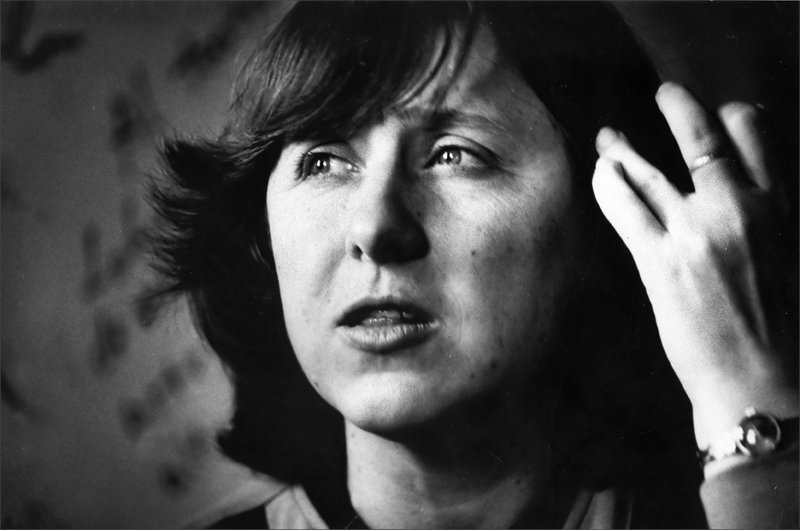
    I was living in Stockholm when Alexievich won the Nobel prize in 2015, which gave her the attention she rightly deserved and meant a lot of her untranslated work appeared in English.  She has been described as an oral historian, a journalist or a documentary novelist at different points and in different countries, none of these labels quite fit. Her books are perhaps better understood as democracies of voice. In Voices from Chernobyl, Second-hand Time and The Unwomanly Face of War, she constructs narratives from hundreds of interviews without allowing a single authoritative narrator to dominate. The authorial voice recedes and history emerges through accumulation, contradiction, repetition and emotion. She is an expert at subtle bricolage, and also clearly a collector.

    The conventional interview is built around extraction. Researchers collect fragments of speech in order to answer questions they have already formulated. Alexievich and her fellow travellers work differently. Rather than reducing testimony to evidence, testimony becomes the architecture itself. The social world appears not as a coherent system explained from above but as a chorus of overlapping memories, disagreements and moments of humanistic intimacy.

    The late sociologist Michael Burawoy argued that public sociology should create dialogue between sociology and wider publics rather than simply transmitting expert knowledge. Yet dialogue requires form as much as intention. Through legibility you connect, and through connection you explain, and through explanation you find purpose.

    Critics of this kind of form worry that combining voices into c composite accounts or journalistic sensibility risks sacrificing authenticity for readability. The concern is understandable, but it assumes authenticity resides only in the individual testimony. Sociological fiction  is not fictional in the sense that it isn’t real, but fictional in its impulse to tell a story beyond assembling a series of facts. It relies on a kind of informed subjectivity (What Candis Callison, a Canadian journalism theorist calls the ‘view from somewhere’). You can go to Wikipedia for the bare facts. Composite narratives acknowledge this overlap without pretending that one interview can carry the force of an entire social condition.

    Composite narratives and narrative writing  can also protect anonymity while preserving emotional truth. They allow researchers working with vulnerable participants to communicate structural realities without exposing individuals to unnecessary risk. More importantly, they permit the articulation of experiences that are collectively felt but individually fragmented. The composite voice is not a fictional invention so much as a representation of shared social experience.

    The New Journalism movement in particular understood the power of polyphony. John Hersey’s Hiroshima remains one of the defining works of twentieth-century reportage precisely because it refused the singular heroic narrative that dominated much post-war reporting, nor did it try to see the atomic bombing of Japan as a geopolitical chess game. Instead, Hersey reconstructed the bombing through the lives of six ordinary survivors. Decades later he returned to those same individuals, recognising that catastrophe is never a single moment but an unfolding biography.

    When I was in my early twenties and in Sweden I learned a lot from reading the novelist and essayist Sara Lidman, who demonstrated that documentary writing could carry both political urgency and profound respect for ordinary speech. Whether writing about the miners in the Swedish north or the Vietnam War, Lidman consistently resisted the temptation to reduce rural communities or political struggle into tropes. Dialect, rhythm and local knowledge remained central to her prose. Voice carries geography, class, memory and history.

    If Sociology wishes to matter beyond the university, it must become more attentive to form. The challenge is not simply to make research accessible but to create ways of writing that embody democratic values. Composite narratives, carefully constructed and ethically transparent, can become acts of public scholarship in their own right. They acknowledge that truth rarely belongs to one speaker. It emerges through conversation, disagreement and memory.

    Perhaps that is the deepest affinity. This kind of worldmaking begins from the conviction that knowledge is collective and storied.  It’s a sensibility that does not assume that meaning resides exclusively with the powerful, but as the historian EP Thompson says, where the lives of normal people are present in their own making.

  • Transcription

    I was recommended Ben Lerner’s novel Transcription by someone I met in Berlin this spring. Along with Mathias Enard’s Annual Banquet of the Gravedigger’s Guild I’ve never felt more seen as an interviewer (the book is actually not about what it claims to be), and by some serendipity I picked up a copy in the bookshop opposite Colombia University in New York and arrived in Providence, Rhode Island at the same time as the protagonist gets off the train from New York to interview their subject in the same city.

    In the book the narrator drops his iphone in a sink and spends a good chunk of the novel trying to deal with the sudden disconnection from organised time, interspersed with memories of his college romances and the days when phone calls were timed and costed a lot of money, and where information on other people was hard to come by unless a mutual friend told you. It’s a plot device that let’s Lerner’s narrator play with the unreliable nature of memory, time discipline, and the question of whether conversations recalled are any more or less real than words committed to the archive.

    I’ve a project on the go in the background at the moment where I am playing around with the hours and hours of audio recordings I have from the past few years and working out where the gaps are for a book I am writing on time (which I hope might appear around 2028 if I can get my act together). I worked out that -give or take – I’ve probably interviewed about a thousand people in my life. Some have been extended chats with a microphone lasting several hours, others have been grabbed questions at press conferences or walking down corridors, sat on trains and at bus stops. The ease of digital recording means that we are now used to the idea that we can have something approaching total recall, and there is evidence that the use of AI and automatic transcription as part of Marshall McLuhan’s extensions of man is actually changing the way our brains function. They’re all here, consciously or unconsciously collected but we still make choices in what we retrieve and attach meaning to.

    What makes Lerner’s very short book so impactful is the way it doesn’t only give us an unreliable narrator but also makes you an unreliable reader. Like with my interviews I found myself leafing back through the novel to check that things I had memorised it were actually there (including writing this, where I was worried I had confused part of the book with something else. As I only had a paper copy I couldn’t even search the keywords). The book has generally been pigeonholed as a well-crafted meditation on technology, but it has more depth than that and really speaks to our own shame in not finding meaning and our constant attempts to rectify it through the assemblage of what we know and don’t know in the flow of time.